
How far is the overseas short play market from the free mode?
The country’s red fruit shorts were on the line for about two years, with the number of monthly live users breaking through to 210 million, leaving Yoyo behind, at an alarming rate of increase, to verify the enormous potential of the IAA (advertising realization) model. Today, similar logic is re-emerging in overseas markets.
With over 5 billion Internet users around the world on the base, there is no less room for free dramas once they rise. Which of the regional markets will be the first to run out of the “Occupines”? Who’s going to be a free short play application at the global level?
Today, we come together on this subject and look into the mouth.
11 IAA applications for market creation 40% download
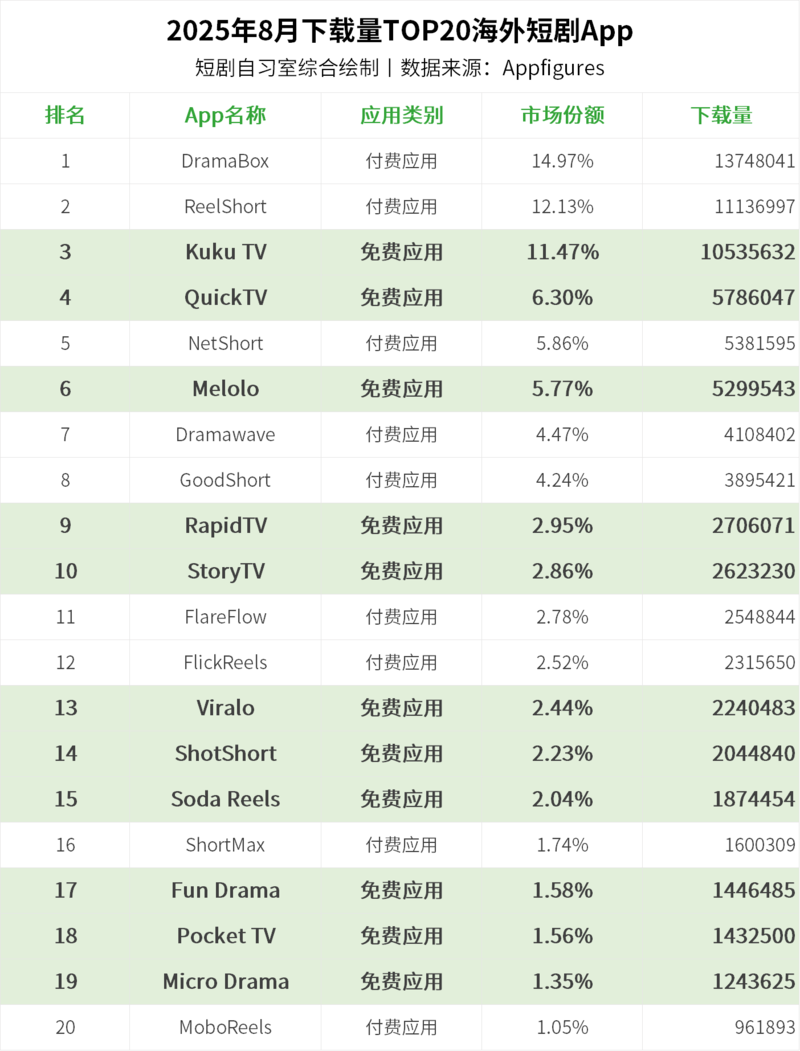
In August of this year, IAA applications received high-light moments: 11 Apps were powerfully killed in the download list Top20, contributing more than 3.723 million downloads, or 41 per cent of the total market.
Note: Here “IAA application”, “free short play application” means “application of advertising as the main business model” and uses “RPD below 0.1” as a quantifiable threshold for determination.
FreeReels, a free-of-charge short play application, was recently launched by the Internet-listed company, Quinlongwanwe (300418), with only 5,000 downloads in July, rising to 290,000 in August and up to 5816.05 per cent a month, with a beautiful first shot on the free track.
In the same month, the pay-for-show application of DramaWave, also under the flag of Kuala Lumpur, approached $20 million a month, after the second named Dramabox. Quinlan Manway, who is “more and more” in the pay track, has not been bet on “full pay” but has opted for a free split.
The signs are clear: the wind of the free model finally blows overseas.
In terms of content, ecology and demand, the overseas short play market has gradually been equipped with free-of-charge conditions.
On the supply side of content, China ‘ s mature production capacity is accelerating. More than 80 per cent of overseas market content is now a translation drama, low-cost, stable supply and still fresh for overseas users. The recent trend towards price reductions has been widespread with the dramatic accumulation of copyrighters in translation.
According to practitioners, today, an explosion has dropped from the previous 50,000 to 30,000, while the non-explosion has decreased to 5-8,000, and the more and more purchases and discounts are available for the free-of-charge model of expendables.
On the ecological side of the flow, the procedural advertising infrastructure is increasingly well developed to support size-based realization. For example, AppLovin Exchange (ALX) supports real-time bidding to increase efficiency in the use of advertising stocks; platforms such as Mintegral help developers to increase their revenues, and advertisers to be accurate and build sustainable IAA flow cycles through AI smart bids and target orientation.
On the side of user demand, the downside of the global economy has driven “the lipstick effect”, with users more inclined to trade time for free content. Just as super-recreational games have successfully opened up the global market with a “free + advertising” model, short plays also have the potential to stimulate video to meet the emotional needs of users.
Free model overseas, not “replicate paste”
Making a free model overseas is not simply a way out of the country’s “free watching + advertising” set. The logical differences behind it are mainly reflected inPolicy complianceandUser BehaviourTwo sides.
The first is the difference between advertising policy and data compliance.
In the case of the European and American markets, the cost of non-compliance is extremely high. Kimi, the head of the overseas program advertising service, shares a case: A DSP company in Paris, France (Demand-Side Platform, Advertising Technology, which provides demand-side platform services, works mainly for advertisers to help them achieve precision advertising) has used A client data for B client placements, with the result that the EU has been directly penalized for bankruptcy.
In other words, overseas platforms have to move in a step-by-step manner in terms of data processing, otherwise the cost of non-compliance is almost “lethal”. By contrast, the relatively liberal regulation of the domestic market and the greater freedom of enterprises to use data leave room for radical operating strategies.

South-East Asia is another picture. The overall stage of Internet development is roughly equivalent to the early stages in China, with users and advertisers less sensitive to digital advertising and relatively weak compliance.
Kimi stated: “High-level users in markets such as India and Indonesia may have some understanding of the form of advertising, but most users and advertisers do not care about the rules.”
In South-East Asia and India, the operating environment was closer to the early stages of the Chinese Internet: regulations were lagging, implementation was loose and the legal risks of enterprises were relatively manageable.
In general, developed markets, such as Europe and the United States, have stringent regulations, and developing countries (T3 markets) have been more liberal, and these differences directly determine the mode of landing.
The second is the difference in user habits.
Kimi told the short play self-study room that in the US-Europe market, the opening ad was not a “gold entrance”. High drop costs do not necessarily translate, and may even trigger user complaints by “opening the screen to unconnected pages, contrary to the original intent of the user”, so few advertisers are willing to compete for this position.
At the domestic level, the opposite is true: the opening page is the first entry point for users, the traffic is scarce and valuable, the advertisers are willing to pay a premium for it, and the media are able to rely on high eCPM (revenues generated by the thousands of exposures) and full investment to generate significant returns.
As can be seen, this is also a free model, with a clear difference in operating logic between overseas and domestic. Such differences not only affect the platform ‘ s business strategy, but also determine the tolerance and error space for new models in different markets.
What market would the overseas version of the fruit be born?
In the discussions of short-time outings, it is often heard that IAAs are better suited to markets with weak payment capacity, while IAP (pay realization) is a market with a strong counterpart.
It sounds reasonable, but the problem is that the market where payments are weak is equally low for advertising eCPM. Adding to the regional differences in the level of development of the advertising industry, the size of the IAA is not as easy as expected.
India is a case in point. The market, which is recognized as a “potential and fee-sensitive” market, the Internet advertising industry as a whole lags behind, and the limited and demanding demand of downstream advertisers, making it difficult for the platform to run the liquidity logic.
“Unless you have a significant number of us, why will admirers with you? A minimum of 10 million active users will be required to achieve sustainable advertising.”)
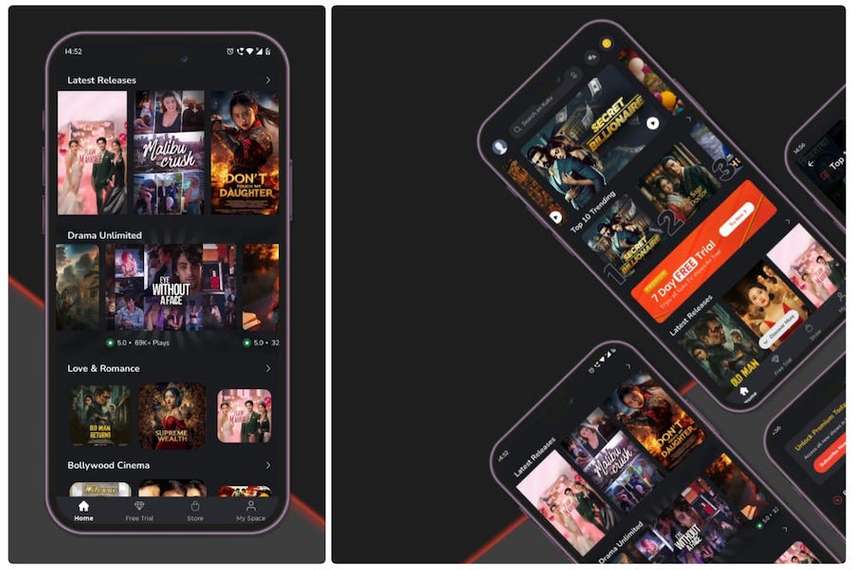
Even Kuku TV, known as India’s first short play application, had just over 70 million downloads. To reach the target of 10 million active users, an active user conversion rate of about 14-15 per cent (i.e. 1 out of every 7 downloaders is active) is required for downloading users.
For reference purposes, Sensor Tower reported that DramaBox retained approximately 17 per cent for the sixth month and about 15 per cent for the twelfth month. This suggests that the retention level of the head platform will be reached if it is to be truly attractive to advertisers.
Looking back at T1 markets like Europe and America, the situation is completely different. Advertising is mature and eCPM is high. Kimi revealed: “eCPM is directly linked to user values and consumer capacity. In the game industry, for example, the European-American incentive video eCPM can go to dozens of dollars, and a Banner ad can reach 3-5 dollars; and the T3 market is much inefficient.”
However, given the strong payment capacity of T1 markets such as Europe and the United States, player entry would be the first to consider IAP or IAAP, rather than IAA.
By contrast, South-East Asia may be a more realistic breakthrough.Mintegral revealed that the short play App inspired video eCPM in South-East Asia, iOS at a cost of about $4.5-10 and Andres at about $3-6.5. DollarI don’t know.
Considerable gains have been made, with a large number of free user groups, combined with the fact that the Internet in South-East Asia is still in its development phase, with large operational space and still having a magnification effect.
It is known that Melolo, a byte byte short play platform, has worked with Mintegral on a cash-in-advertisement partnership, focusing on South-East Asia.
So the question is, who’s going to make the “Occupant”?
Look at domestic players first.
Byte beats, Quinlan Manway, with both content and capital, have led to free short play applications; Chinese online, ReelShort, nodes of technology, and the new age also hold a great deal of copyright, with a wealth of experience in going out to sea, although not yet on the free track, are also considered potential enemies.
The industry has revealed that some of the head platforms have entered the IAA track. There are two reasons for this: the search for new underpinnings in times of uncertainty and the real vision of the potential and prospects of the IAEA.
The problem is that it is also clear that there is a lack of a well-established flow pool like the tremors abroad, that the cost of getting a customer is high and that many, if not ten, times the cost of replicating the phenomenonal growth of the nuts.
And look at overseas local players.
Japan and Korea already have a number of television stations, entertainment giants and Internet enterprises that play the role of producer, producer or distributor. Of these, Naver, relying on nearly two thirds of the market for search and portals, launched the short play platform Clip, which is a small number of players with byte “content+flow” advantages.
On the Indian side, the old production company in Mumbai, O.U.T. Media, has been holding hands with indigenous short play applications such as Kuku TV, QuickTV and head-on OTT platforms that plan to produce more than 100 units a year, with ambition and content capabilities…
However, the gap can be seen from the downloading of the list, with low rates of overseas applications and still lagging behind Chinese players in terms of competitiveness and growth. The reason for this may be that the short play is not as well understood as the Chinese platform that emerged from the fierce competition.
In general, there are advantages for players, both middle and foreign, and domestic platforms are good at fast-testing and scalable content supply, and overseas platforms occupy channels, brands and local user relationships.