Google has signed an AI agreement worth $30 billion with SpaceX under Mask. According to a paper submitted by SpaceX to the United States Stock Exchange, Google will pay $920 million per month to SpaceX from October this year to June 2029 in exchange for XAI data centre computing support.
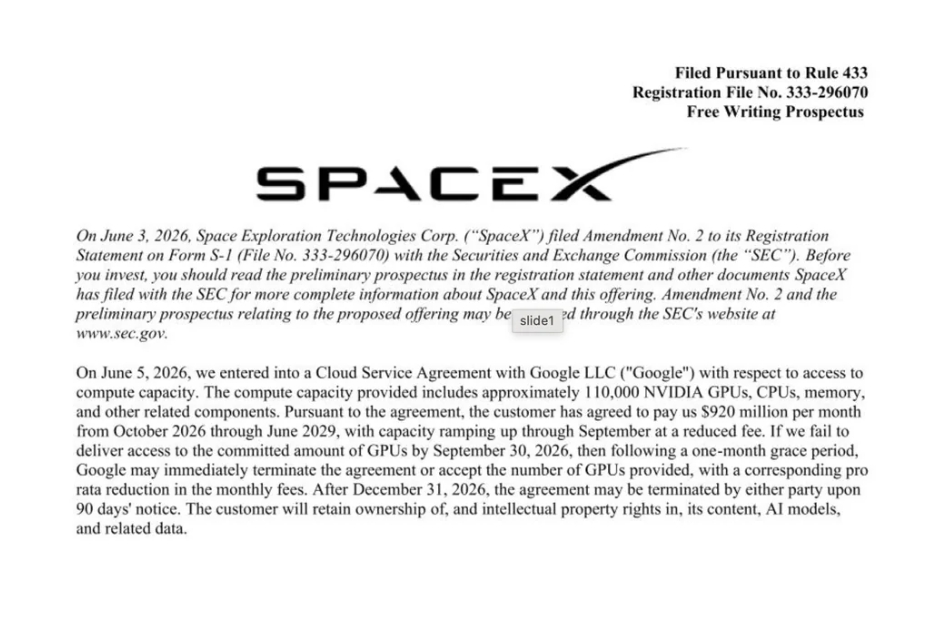
The document indicates that Google will receive approximately 110,000 British Weibo GPUs in SpaceX data centres, as well as access to CPUs, memory and other components. In the document, SpaceX indicated that Google could terminate the agreement immediately if it “could not provide the amount of the commitment by 30 September 2026” or accept the amount of the GPU at a lower rate after a month’s grace period. After this year either party may terminate the agreement provided that 90 days’ notice has been given.
According to CNBC, Google spokespersons stated that the move was “to ensure that we have the ability to transition to meet the surge in client demand for our proxy platform, Gemini Enterprise, which is even beyond our expectations”. Google launched a subscription service for large businesses last October, Gemini Enterprise.
SpaceX ‘ s AI department recorded operating losses of $2.5 billion this quarter, while income was only $818 million. Mask claimed that XAI ‘ s Grok model and chat robots were rivals of AI leaders OpenAI, Anthropic and Google products, but his company ‘ s products had not yet had a significant impact in a dynamic market.
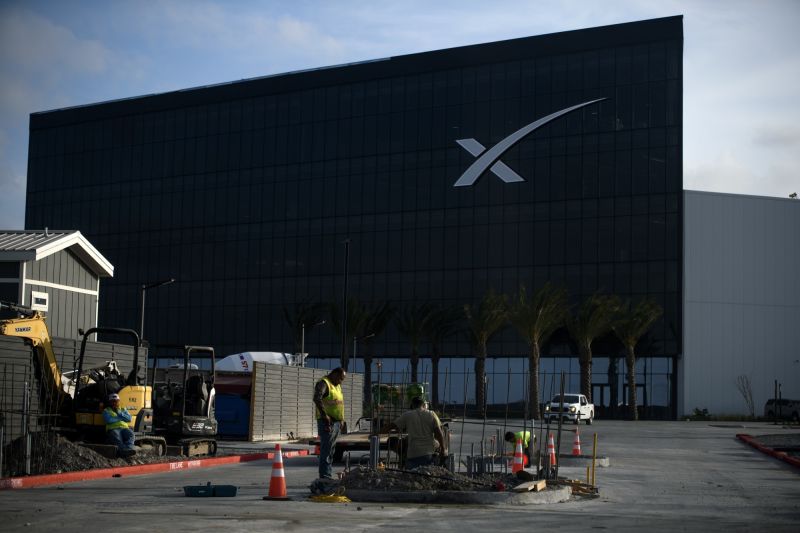
Earlier this year, SpaceX initiated a number of lawsuits and government investigations because the flag Grok AI allowed users to generate large-scale content that was deeply forged. In March, following a brain drain from XAI, Mask stated that Grok needed to be rebuilt. Subsequently, the company entered into an agreement to grant it the right to purchase the initial company Cursor with an AI code of $60 billion.
At the same time, SpaceX is trying to make money from the data centre originally built to handle the Grok-related workflow. In the presentation, SpaceX listed Google as a competitor in the field of connectivity, and SpaceX operated its Starlink satellite Internet service, while Google operated its fibre-optic broadband operation. In the AI area, SpaceX indicated that it competed with Google and OpenAI, Anthropic, Meta and Microsoft.
Google is significantly increasing AI spending. In April, the company revised its capital expenditure projections for this year upwards from the previous $175 billion to $185 billion to $180 billion to $190 billion. This week, the Google parent company Alphabet indicated that it planned to sell $85 billion in equities, including $10 billion in investments through Birkheil Hasawai, in response to “unprecedented customer demand”.
When entering the infrastructure leasing market, SpaceX also faces competition from a range of companies such as CoreWeave. Google also had cloud computing agreements with SpaceX in the past, but now there is a switch of roles. Five years ago, Google agreed to provide SpaceX with computing and web resources to help provide Internet services through its Starlink satellite. The agreement, which required SpaceX to install ground-based stations at the Google Data Centre, marked a major victory in Google ‘ s efforts to synchronize with Amazon Web services and Microsoft Azure.