
Recently, a new black horse — FlareFlow — was broken into the overseas shortshow market. The Chinese-language online short play App broke into the top five two-end, the top three-end, and downloads and double-lined income curves in just five months.
Its slogan is also very simple and straightforward: “One minute of story, the resonance of the world.”

Sounds familiar? Indeed. It looks like a “ReelShort 2.0” version. But the difference is, this time, the FlareFlow, instead of the old style of “hunter + dog blood,” it’s a combination of emotional resonance, social issues, and globalization.
This content, based on cultural neutrality and emotional resonance, is clearly much easier to understand and enjoy in the international context than the straight-and-white style of the “Big is in love with me” series.
And FlareFlow’s biggest weapon, actually AI.
The large Chinese online self-study model, Chinese, is deeply involved in the production of scripts, white colour, reprogramming and even localization. To sum up in one sentence, the human writer provides inspiration and AI completes industrialization. While other platforms are still struggling with translation, voice and rhythm differences, FlareFlow has been able to develop 10 topics a week, with 10 clips a day.
AI intervention not only means reducing efficiency gains, but also transforms short-time production into a replicable and fast-paced industrial system. When content changes from creativity to data, from emotions to algorithms and from subjective narratives to structural templates, everything becomes efficient. This also gives FlareFlow a unique advantage in content efficiency in the Red Sea, where algorithms and purchases compete.
From the online article “The Empire” to the short play matrix.
Many people think that FlareFlow is a miracle, but in fact it is the result of 20 years of online Chinese content. The company, which is not new, has witnessed every turn of China’s digital content, from the earliest “Internet age” to the present “Ai age”, and has also experienced a return to numerous forms of content.
In that current node, the Chinese web did not leave a central theme, namely, how content was re-produced, redistributed and consumed.
From 17K to April, over 5.6 million content assets and 4.5 million authors were saved online in Chinese, which meant that it had not only a huge amount of text resources but also a much more sophisticated set of content ecosystems. It’s like a huge story tank, which stores China’s richest Internet emotional template, narrative model and sample of people.
And the appearance of FlareFlow is just another externalization of the gold mine.
Over the years, the Chinese online has been thinking about how to turn the emotions of words into the tension of video. In the past web-based ecology, reading was one-way, inner-concentrated, and readers built images in their minds; in the age of the short play, content had to be out-of-the-box and immediate. To complete a story within one minute, it must be precise enough to release sufficient emotional density within a limited period of time.
And FlareFlow, using AI to find this rhythm.

The Chinese online self-study Chinese Free Master Model became the engine of this transformation. AI is able to extract “emotional templates” from thousands of web-based materials to identify which conflicts can resonate and which bridges work in different cultural contexts. It automatically disintegrates the structure of the drama, indicating emotional peaks, inverted points, and orgasms. This is followed by visual expression, role-building and cultural adaptation by the human team.
This is not only a test of how AI drives creation, but also of the replicability of Chinese stories in global narratives. At present, FlareFlow has supported English, Japanese, Spanish, etc. in several language markets, and combined with localization of voice and culture to regenerate the same story in different cultural contexts.
A hot subject can be adapted locally in different markets, and the same IP can be reproduced in a multilingual system. The resonance of the story is consistent and the grammaticals at the outer level vary from place to place. This model of IP+ algorithm distribution allows the Chinese-language online to build a content matrix that is a bit like the short play of the Disney universe.
However, behind the glamorous data curve, the FlareFlow is no exception to the problem common to the short play industry, the profit dilemma behind high growth.
Heat and loss. “Growth illusions” about the short play.
FlareFlow seems almost impeccable. The narrative of globalization seems to have finally found the rhythm of the algorithm that belongs to it, as the downloading curve ends and income growth doubles. But when the camera pulls out, the shadow behind the data begins to appear.
Outside the flow, where’s the profit?
In the first half of 2025, an online newspaper in Chinese provided answers. The revenues were indeed beautiful and the growth was significant; however, net profits continued to lose $226 million. In other words, the FlareFlow ‘magic curve’ is still made of real and white. This is not a Chinese online dilemma, but a general disease in the entire short-time industry.
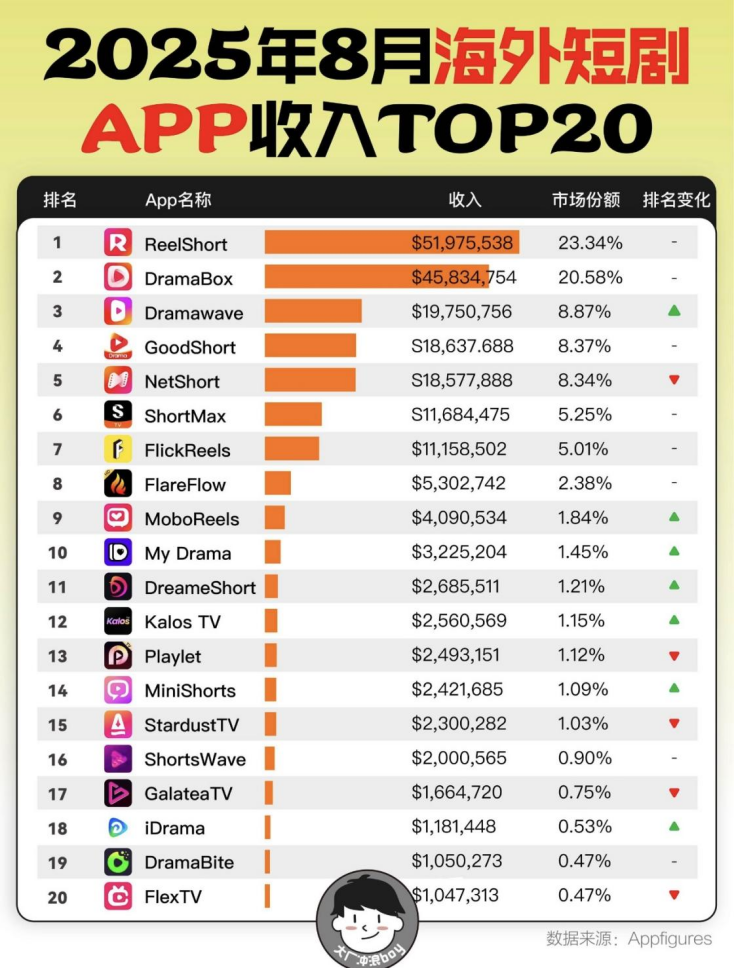
Photo illustrating the collection of short theatre camps overseas in August 2025. Source: Little Red Book.
According to Mobvista, in the first quarter of 2025 alone, the number of overseas plays App tops exceeded 120, an increase of 120 per cent over the previous year. In other words, the market is no longer the Blue Sea, “Who wins ” , but the Red Sea.
In such an environment, FlareFlow must face both pressures. The first is the sharp increase in the cost of placement, the prices of advertising platforms such as Meta, TikTok and others are no longer friendly, the algorithm dividend is diminishing and the purchase of ROI is continuing to decline. The second is the homogenization of content. As “reverse, revenge, luxuries, taboos” became the standard set for a sea-bound play, the audience’s tolerance fell at an alarming rate.
As a result, FlareFlow had to do an almost fatal thing. That’s redefinition of the economics of content with AI and data.
In the past, the short play sought to produce the explosive and exchange the burning money for the flow, while FlareFlow was more like a data-driven laboratory. Its back-office system tracks in real time indicators such as “overrate” “node retention” “chapter fee conversion” for each play, and algorithms automatically indicate a weak or slowness in the detection of a curve. The creative team was immediately reminded to adjust the scene, shorten the paragraphs and even rewrite the text.
In a sense, this is no longer a video production in the traditional sense, but rather a creation created through algorithms. AI is no longer an aid, but a director. The story is no longer inspired, but determined by data. The FlareFlow content team is more like an operator than a writer.
Of course, this high actuarial level has led to solid efficiency gains. The FlareFlow script validation cycle has been reduced to half the industry average, and it will be able to test more subject matter under the same budget, while optimizing the situation through data feedback and maximizing the rate of explosion.
But the other side is obvious. When everything is modelled, the temperature of creation is diluted. The tears and resonance of the audience are calculated with precision for a predictable transformation rate peak.
At the same time, FlareFlow faces another more difficult trap. That’s the logic of “burning money for scale” and is consuming long-term profitability. Advertisements in overseas markets have been placed in extremely high volumes. Each round represents a high cost to the customer. Once the drop has stopped, the flow has declined and the revenues have collapsed.
Even more troublesome is that the short play has a very short life cycle. One episode, from the top line to the top of the heat, is usually only three to five days. This means that the platform needs to be replenished at a faster pace to sustain it. The more rapid the production and the larger the inventory, the higher the content costs.
Thus, the true test of FlareFlow is how this high-speed machine can go further.
The second half of the short play.
When the dividend cycle of the short play industry ends, the only thing that can be remembered in the Red Sea for a long time must be not “explosion” but “systems.” This was made clear online in Chinese, whereupon it began to move from a single-point platform to a complete ecology covering upstream production and downstream distribution.
Algorithms are responsible for breaking down text, extracting emotional curves and predicting user resonance, while creative teams use industry standards to visualize and adapt to local culture. Ultimately, all production chains are integrated into a closed ring system.
The creative team uses industry standards to achieve visualization and cultural adaptation, and all links are integrated into the same closed loop system. As a result, the Chinese online network is no longer dependent on a single brand, but rather supports the simultaneous growth of multiple platforms and markets through an entire content supply chain.
Just the center of the system, still AI.
At the creative end, AI is responsible for the design, modelling and style translation of the subject, and can even generate a cultural template based on the target market. North America prefers fast rhythms and strong conflicts, Japan and Korea focus on emotional resilience, and Latin America likes color saturation and reverse narratives. At the distribution end, AI is involved in the editing of materials, the production of files and the placement of advertisements, monitoring the performance of the CPM in real time and the dynamic optimization of the direction. At the operational level, pricing, incentives and retention strategies are projected through the user life-cycle model.
It can be said that the business logic of FlareFlow has been rewritten by AI.

But real innovation is not just technology, but culture.
The first half of the short play is distributed by poor information, visual stimulation and algorithms, but in the second half it depends on cultural and emotional resonance. What FlareFlow wants to do is therefore a globally readable narrative.
Neither blindly export Chinese-style stories nor embrace Western aesthetics, but rather use universal sentiment as a bridge to allow stories to naturally cross cultural boundaries.
However, the road is not easy. Content ecology takes time, and AI inputs entail high technical costs. More difficult is how to make algorithms understand cultural boundaries, because AI can predict emotions but it is difficult to understand ethics. The second generation of risks that FlareFlow has to face is how to avoid “over-silverization” and respect multiculturalism in global narratives.
However, FlareFlow ‘ s ecologicalization attempts have triggered a chain reaction within the industry. An increasing number of teams have begun to move from heavy to systematic production and AI-driven creativity. The short play is also leaving the first half of the barbarous growth and entering the second half of the structural competition.
Speed remains important, but who decides who can live and who can build a system of standards, efficiency and sustainable output.
Every click, every stop, every pay node, is feeding on the next creation. The translation of flow logic to ecological logic is the sign that the content platform is starting to mature.
Thus, what really matters is not to hit the top, but to build a sustainable content ecology.
Conclusion No. 1
The story of FlareFlow was a party and a sober dream. It demonstrated the industrialization potential of the Chinese short play and revealed the universality of the profit trap.